A common standard for electronic evidence.
Defining how digital records are examined, documented and presented — so they hold up in every courtroom in India.
Examiners the courts can trust.
A national framework that certifies competence, enforces method, and gives the judiciary a credible point of reference.
One council, every jurisdiction.
Connecting forensic labs, investigators, academia and the bench around a shared body of practice.Exclusively for the electronic evidence requirements
A public register the judiciary can rely on.
Every E³-certified examiner is listed, verified and accountable — building toward statutory recognition under Section 79A of the IT Act, 2000.
A national curriculum for a national discipline.
From mobile and cloud forensics to virtual-asset tracing, the Council prescribes a uniform body of knowledge — anchored to the BSA 2023 and BNSS — so every examiner is trained to the same standard.
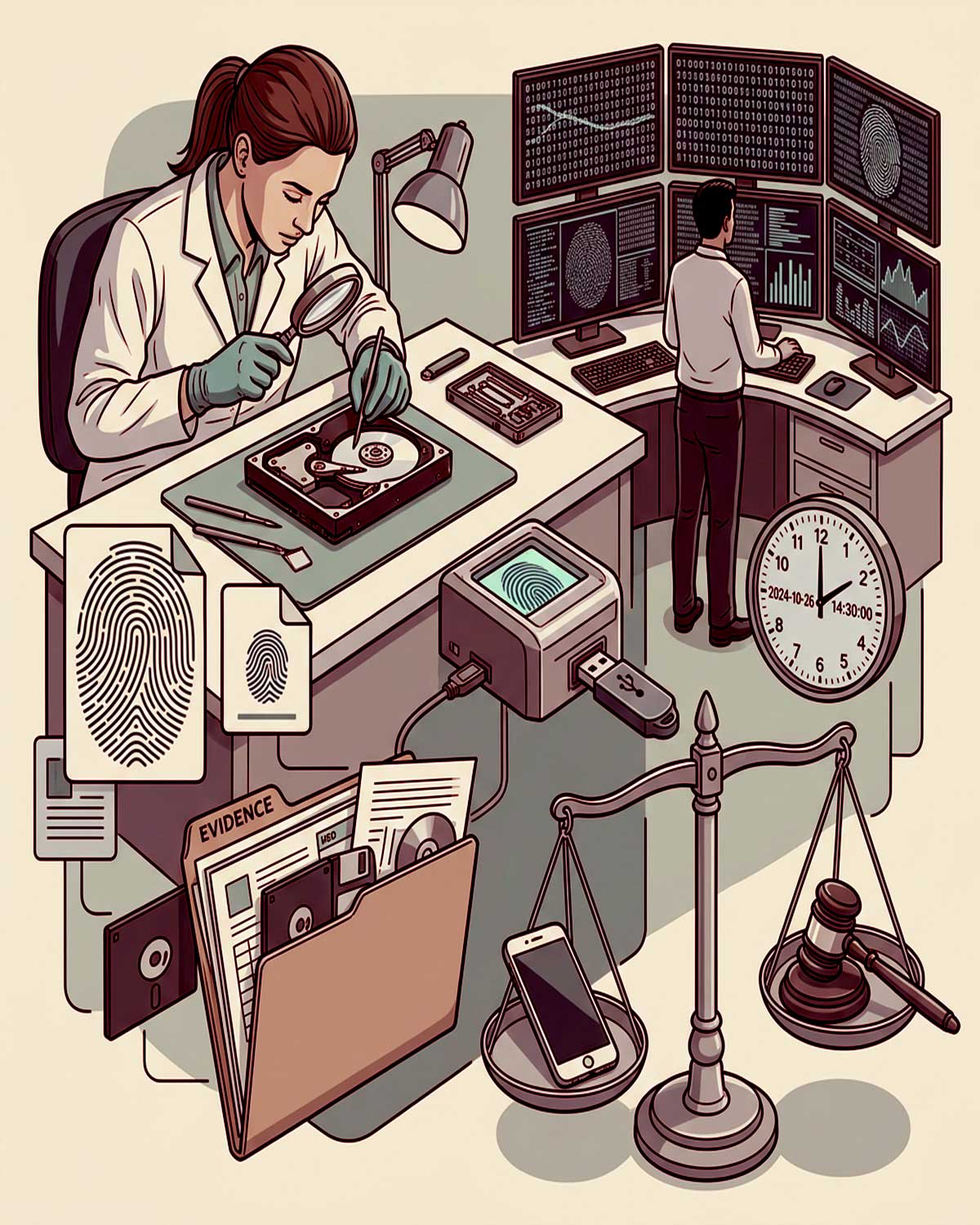
The E³ Council is a professional standards body for the discipline of electronic-evidence examination across India’s legal and investigative system.
As digital records become the decisive proof in courtrooms — messages, logs, media, ledgers and device data — the question is no longer whether evidence exists, but whether it was examined correctly. The Council exists to answer that: to set the method, certify the people who apply it, and give judges, investigators and counsel a single, credible reference for what good practice looks like.
Four commitments that define the work of the Council.
Standards & Certification
Author examination protocols and certify qualified electronic-evidence examiners against a national competency framework.
Admissibility & Trust
Strengthen the evidentiary weight of digital records under the Bharatiya Sakshya Adhiniyam through defensible, repeatable method.
Capacity Building
Train examiners, investigating officers and judicial staff so that sound practice scales across states and agencies.
Research & Policy
Advise legislators and regulators on emerging threats — and keep the standard current as technology moves.
The domains we examine — and where the discipline is heading.
Mobile & Cloud Forensics
Acquisition and analysis across devices, apps and hosted accounts.
Network & Memory Analysis
Live capture, traffic reconstruction and volatile-memory recovery.
AI & Deepfake Detection
Authenticity testing for synthetic audio, image and video media.
Blockchain & Crypto Tracing
Wallet attribution and transaction-flow analysis on public ledgers.
IoT & Vehicle Forensics
Embedded, telematics and edge-device evidence recovery.
Data Recovery & Integrity
Reconstruction, hashing and chain-of-custody verification.
A three-horizon forecast for electronic evidence in India.
Indicative roadmapFoundation
Charter the council, publish the first examination standard and open examiner registration.
Scale
Accredited training across regions; certification recognised as reference practice by courts.
Standard of record
Electronic-evidence examination governed by a single, continually-updated national standard.
Build the standard with us.
For membership, certification enquiries, partnerships with labs and agencies, or media — reach the secretariat below.